Theme Layout

Boxed or Wide or Framed

Theme Translation

Display Featured Slider

Featured Slider Styles

Display Grid Slider

Grid Slider Styles

Display Trending Posts

Yes

Display Author Bio

Display Instagram Footer

Dark or Light Style

Showing posts with label Philippine Jewelry. Show all posts
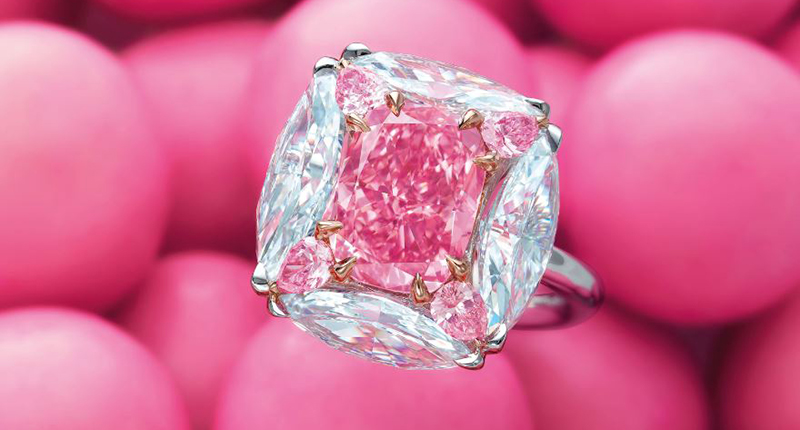
3.43ct Bubblegum Pink Diamond takes the Spotlight at Christie's Hong Kong Jewelry Auction

3.43ct Bubblegum Pink Diamond takes the Spotlight at Christie's Hong Kong Jewelry Auction


With the trend of coloured diamonds continuing its surge at international auction events, a 3.43 carat cushion cut diamond known for its bubblegum pink appearance has just sold for 7.5 million dollars at Christie's recent Hong Kong auction. The stone was mounted onto a ring designed by Moussaieff, alongside several more pink diamonds and some marquise shaped white diamonds as well.


Initially estimated between 6 million and 8 million US dollars, the beautiful ring did not disappoint when it came to the actual sale. The prominent piece was considered as one of the premier lots sold during the 'Magnificent Jewels' event held regularly by the famed auction house. The sale in its entirety encompassed purchases of over 40 million dollars, and showcased many other coloured gemstones- such as Colombian emeralds and brilliant blue diamonds.

Photography: Christie's Auction House | Magnificent Jewels

Read more »
Gemcamp Laboratories
0 Comments

You Might Also Like

Instagram Jewelry Shops VS Traditional Retailers, Where Do Filipinos Buy Jewelry?

Instagram Jewelry Shops VS Traditional Retailers, Where Do Filipinos Buy Jewelry?


Many instagram jewelry stores are now catching up to the classic brick-and-mortar shops by leveraging the social appeal of owning jewelry. An ability to quickly share your brilliant diamonds and gemstones visually to hundreds of thousands of followers can make for a very good advertising jump.


Instagram's influencer society is now growing rapidly, and online sales through the platform's unique presence has become a way for new jewellers to break into the market. Nicole Wegman started her instagram store Ring Concierge in 2013, and now makes 6 figures in sales, as mentioned recently by an article on Business Insider. Many foreigners and Filipinos are approaching instagram as a solo-method of jewelry sales, as it provides low overhead costs and is backed by tech-giant Facebook.

Instagram allows people to comb through troves of beautiful jewelry posts put up by their favorite stores, all in a matter of minutes and from the comfort of their phone. This ease of shopping (or even window-shopping) saves time and attention. Instagram stores are now growing in number, and are also being accepted by the general public as one of their go-to places for jewelry purchases.


Are these trendy digital stores going to overtake retail establishments though? It's hard to say. Digital venues have been catching up in sales records ever since a decade ago. There was once a time when famed diamond online store 'Blue Nile' was said to be almost equal in sales to diamond giant 'Tiffany & Co.', despite being mainly an online portal. Many people believe that with the advent more enhanced visual sharing, digital stores may overtake physical stores in performance within the next decade, although this is only the speculation of some.

There is also no harm in having both a physical store and a digital outlet for your jewelry products, many large companies are doing this. What most of them fail to realize, is that instagram and facebook stores should not be treated just as another medium for advertisements. These are big marketplaces that older generations of jewellers sometimes overlook.


Younger entrepreneurs, fashion leaders and even jewelry collectors are all recognizing the value of having an instagram store as their main platform for business. This isn't just a trend anymore, a shift in the power of retail is approaching. Which side will you put your time and effort into cultivating?
Read more »
Gemcamp Laboratories
0 Comments

You Might Also Like

A Bit of Jewelry Trivia for Beginning Filipino Jewelry Collectors

A Bit of Jewelry Trivia for Beginning Filipino Jewelry Collectors


Here we'll just briefly discuss some of the commonly misunderstood concepts observed in the local trade. Now, certain people may already be aware of these, but it seems that every now and then some people express confusion regarding what many terms mean, and what they don't mean. This short article should give you a bit of insight (and trivia) about gemstones and jewelry.


1. 'Emerald Cut' refers to a specific cutting style and shape, not necessarily or specifically to the emerald gemstone itself. Most diamond collectors may be familiar with the popular term 'emerald cut', but some people are not aware that this term refers to how a gemstone (diamond or any other) is fashioned and polished into a rectangular shape with step-cut (four sided) facets on its body. Emeralds themselves, are very often cut in this rectangular style, because of the way their crystals grow, and the intention of gem cutters to save the most weight. Today, many other gemstones, such as aquamarine, diamond, amethyst and quartz are frequently fashioned as 'emerald cuts'. This specific cutting style is well suited for stones of high clarity, or stones that tend to form elongated or columnar in nature.


2. Rubellite is not ruby. We've come across a few parties that previously believed rubellite to be a form or type of ruby. This is simply not true. Rubellite is a trade named color variety for red to pinkish red tourmaline. Both tourmaline and ruby maintain very differnet gemological properties, and prices. Ruby is traditionally much more expensive than rubellite tourmaline, given a situation where color intensity and clarity levels are generally equal.


3. The term 'synthetic' is different from the term 'imitation' or 'simulant'. A synthetic gem refers to a man-made counterpart of that gem, with the same essential crystal structure and chemistry. A synthetic diamond, is still made of carbon, crystallized in the cubic crystal system for example. This is in stark contrast to an imitation gem (also called a simulant gem). An imitation gem merely looks like the gem it is trying to copy. Moissanite for example, is an imitation of diamond, as it is made of silicon carbide instead of pure carbon. It also grows in a different crystal system.


4. Cultured Pearls, not wild pearls, comprise a majority of all middle to high-end pearl jewelry collections in the country. Some people are not aware that over 99% of all pearls used in the jewelry industry today (especially the mid-to-high ranges) are actually cultured pearls. Cultured south sea pearls for example, are among the most expensive pearl items you can procure, with some necklaces costing hundreds of thousands of dollars. For pearls there are three categories you have to be familiar with. Imitation pearls, cultured pearls and wild-caught pearls. Imitation pearls are simply simulant items usually made of plastic or glass coated with iridescent substances. Cultured pearls and wild-caught pearls both come from actual live animals (mollusks, oysters etc), but a cultured pearl means that man has assisted the developmental stage by putting either a piece of mantle tissue or a shell-bead nucleus inside the mollusk in order for it to coat with nacre over long periods of time- to eventually form a pearl. The nacre layers are still organically produced by the same animal. Wild-caught pearls statistically speaking, are rare coincidences in nature today, and almost never come in large enough symmetrical shapes (round, oval etc.). The vast majority of fine pearl jewelry makes use of cultured pearls. (This statement does not apply for giant clam pearls, which we do not currently test at the laboratory).


5. Diamonds are not indestructible. We would not suggest that people perform any possibly-destructive test to find out if their stone is actually a diamond. Stories of sandpaper-scratching or hardness testing using rocks or other materials seem to be very prevalent among Filipinos. While diamond is the hardest mineral to 'scratch', it does maintain multiple planes of atomic weakness (cleavage). When struck in specific directions, a diamond can chip, fracture or even split in two. Thin areas of a diamond, like its girdle or culet, are also very prone to breakage. This can still happen even if it impacts with something with a generally lower hardness, if done in certain ways. Additionally, diamonds can also burn if subjected to high enough fire temperatures and sufficient levels of oxygen (because they're still carbon).


6. Proper heat treatment in rubies and sapphires is okay and an accepted part of the trade. There are those out there who detest the thought of their rubies being treated, but the vast majority (over 95%) of rubies and sapphires today are actually subjected to some form of heat treatment. It's a normal practice in the industry, and can bring out a stone's potential when done in the correct conditions using appropriate methods. While premium prices do exist for unheated stones, it's just as likely that an originally duller stone's value can eventually be heightened by subjecting it to heat treatment and increasing the overall color quality.


7. Glass-filled rubies are not nearly as expensive as natural or heated-only rubies. These items can be filled with glass in up to 50% of their composition. If someone tells you that their value is basically the same as rubies that aren't filled, you should probably do a bit of research first. Most likely you'll find that glass-filled rubies were originally very opaque-looking low-quality stones. Their durability post-treatment is also not that stable, according to many of our visitors and our own observations.


8. DIY Handheld Diamond Thermal Testers cannot differentiate between natural diamonds and lab-grown / man-made diamonds. These instruments make use of a technology that measures thermal conductivity, a property that is essentially the same for both natural and synthetic diamonds. Other testers like duo or multi testers that also check for moissanite, make use of electrical conductivity. These also cannot separate CVD or HPHT lab grown diamonds from natural diamonds. Advanced spectrometric testing is more suitable for this differentiation, which we make use of here at Gemcamp Laboratories.
Read more »
Gemcamp Laboratories
0 Comments

You Might Also Like

The Growing Trend of Permanent* Jewelry

The Growing Trend of Permanent* Jewelry


For a lot of people, buying jewelry denotes having a varied collection of fashionable yet interchangeable pieces that one could mix and match for different occasions. Most would say that jewelry, much like all other accessory types, pairs itself to the moods and tastes of wearers- which can change from day to day.

In contrast to this, a growing trend seems to be banking on the complete opposite mentality. Although not technically new, people are now emphasizing the permanence of certain pieces of jewelry in their lives.

I'm sure you know some friends who every single day wear the same necklaces or rings that were given to them family heirlooms. Wedding bands also work in he same way- that you never really remove them much after you say your vows. This concept of jewelry holding a deep sense of sentimental value can be seen in a revised retro-classical trend called permanent jewelry.


Photography by American jewelry design store Catbird, which just opened a welding annex for this trend of jewelry usage.

This basically involves certain pieces (most notably bracelets and necklaces) that are subtly yet strongly welded from end-to-end around a wearer's body. The length or size of the piece is usually just large enough to fit comfortably, but not to squeeze out of or slip past.

Many who follow this trend, do so with the purpose of commitment- much similar to how engagement rings act as a promise of marriage. These people commit to wearing their jewelry items for long durations or even for their entire lifetimes. In some cases this act is done because the person wants a visual and lasting remembrance of someone or something, which could be a partner, a promise, a family member or even a milestone in his or her life.


Permanent jewelry usually takes the form of more simple, less showy styles. If diamonds or other precious stones are used, these are most often of lower carat weights to provide a long-term comfortable feel to the piece. It would also be unwise to wear a giant 3ct diamond for example, to some certain localities, like a dark alleyway or a place known for pickpockets.


Whether the jewelry styles you subscribe to, are for permanence or switch-ability, the industry always creates more trends that seem to relate to most people's sentimental needs in life.
Read more »
Gemcamp Laboratories
0 Comments

You Might Also Like

Did You Know? Filipinos Rank Among Asia's Most Dedicated Diamond Buyers Today

Did You Know? Filipinos Rank Among Asia's Most Dedicated Diamond Buyers Today


In every part of the world, you'll notice a specific trend that governs the tastes of people who see themselves as serious jewelry collectors. Many nationalities differ in their own preference of what gemstone provides the most satisfaction in a wholesome sense- appeal, investment, cultural significance. Filipinos undoubtedly have ties to two of the gem world's front runners in the trade, pearls and diamonds.

Pearls have been revered by Philippine culture for decades, due to the archipelago's deep-rooted connection to the Palawan and South China seas. The golden south sea pearl (Pinctada maxima) is one of our country's premier luxury exports, and is indeed one of the world's most beloved gems.


The majority however, would primarily choose to purchase diamonds over any other precious or semi-precious gemstone. The culture of giving diamonds as gifts, not only during engagement ceremonies and weddings, but also during many other family-oriented occasions, is quite prevalent among much of the population today, especially in the bigger cities of Manila, Cebu and Davao.

Filipinos have a penchant for selecting investment grade diamonds, possibly stemming from international influences that have westernized our tastes in jewelry. Diamonds after all, are the world's most widely marketed fine-gemstone, and account for more than 76% of the international gem-trade's business activity.


If you take a look at other countries, you'll find that each has its own specific gem of choice among their societies. China has a great admiration for jade, which can come from either the jadeite or nephrite species. Colombia puts importance on Emerald, as the Muzo and Chivor areas remain to be some of the planet's best sources for the finest green gems.


Our history of being a modern, partially westernized country in Asia, promotes a population where choices tend to agree with global preferences and selections. Most of the younger generation follow the habits of their predecessors, and today's millennial population also believes in the symbol of commitment and eternity that diamonds convey. We are indeed, romantics at heart, and a stone that can travel through centuries unfazed, would genuinely appeal to that part of us.

After diamonds, pearls are the most widely purchased gem in the country, followed by a three-way tie between ruby, sapphire and emerald. These fine varieties are directly above popular more affordable stones like amethyst and citrine.
Read more »
Gemcamp Laboratories
0 Comments

You Might Also Like

Are People in Southeast Asia Re-selling Their Diamonds in Favor of the Simple Life?

Are People in Southeast Asia Re-selling Their Diamonds in Favor of the Simple Life?


2018, Japan-- It's been observed that the local jewelry-owner population has been selling off unwanted jewels for cash at an all time high. Re-selling their old items to buyers in China and India, and seeking a much more simple lifestyle. This coincides with the Japanese practice of danshari, and can be observed right now in a large section of the country's older generations. Shedding the jewel-encrusted accessories in favor of vacations abroad with the family, or delicious dinners with friends, seems to be a popular notion nowadays in cities like Tokyo and some other vastly populated areas.

China has been one of the biggest international markets for jewelry this decade, and this statistic seems to be growing by the year, as most of the country's newly-rich generations seem to be acquiring a taste for luxury-as-an-investment.


In order to re-sell their diamonds and jewelry however (many of which are inherited from their grandparents or parents), people normally have to seek out the help of gemological laboratories in order to accurately identify and appraise their items. Once this is taken into account, they often liquidate their gemstone assets through friends, word-of-mouth, or through online exchange sites that even allow trade overseas.

Despite this trend, it is not uncommon for the owners to sell off their items for less than what they had originally paid for. Selling your gemstones to pawnshops or even jewelry shops will usually entail low prices, as business people who purchase them only do so for profit. Be prepared to wait a long while, if you are wishing to get your original monetary amount back. Although diamond does appreciate, so loose diamonds (unset) are particularly fast-moving in some countries like the Philippines and India. It is still possible to sell them for a profit, if you are able to get accurate information on price valuations from a reputable gemologist appraiser.


The two biggest trends causing the re-sale of old jewelry these days are: The utilization of money gained for more practical purposes- such as paying for housing, or diversifying assets, and also for diminishing luxury clutter- or basically creating a minimalist way of living. Most Filipinos these days actually engage in the luxury-purchasing of tech-related products. It's been shown that these are sometimes bought by younger generations (even for gift-giving) rather than fine jewelry items. Millennials have also been documented to sell-off heirloom jewelry to people who would appreciate them more, and instead just use the cash to buy iPhones, tablets or new laptops which they could use for both work and leisure.

Diamonds and gemstones are sold and resold according to their identities and grades. People looking to re-sell their jewelry items should consult with a proper gemologist so as not to undervalue or overvalue their possessions, as well as to avoid getting cheated or swindled.


Gemstones and diamonds are some of the most stable hard assets, so selling them for a high price is still very much a viable option, even for the private sector. Just make sure that you know what it is you're selling. Seek out gemological support from experts in the field. Our laboratory has helped Filipinos save hundreds of thousands of pesos by simply giving them information on their gems that could help them better price their items for the market in fair and realistic conditions.

Apart from Japan and the Philippines, other countries in Asia seem to be continuing their purchases of diamond and diamond related jewelry at a steady pace, with some highs and lows peaking throughout this past 2017. China in particular has been consuming a great percentage of the jewelry market, growing its luxury sector by exponentially higher rates compared to previous years.
Read more »
Gemcamp Laboratories
0 Comments

You Might Also Like

Jewelry Tips: Illusion Cluster Settings, The Practical Filipino's Choice for Diamond Jewelry Today.

Jewelry Tips: Illusion Cluster Settings, The Practical Filipino's Choice for Diamond Jewelry Today.


One of the key aspects of the jewelry trade is a sense of rarity and exclusivity. Bigger diamonds have always been able to quickly draw the attention of wandering eyes due to their brilliance and sparkle. The larger stones also tend to rake up extremely steep prices on the market, and in today's practical societies, not everyone wants to shell out a tremendous reservoir of cash just for a single ring.


Enter the illusion settings, which can be divided into pure illusion types and illusion cluster types. The latter having one larger center stone in the middle of many smaller stones, and the prior consisting of several small stones arranged in a specific orientation. Either way, the motivation for these types of setting is clear- to create the semblance or appearance of a much larger stone, but within the boundaries of a smart budget.


The reason for this lies in the fact that smaller diamonds, especially melee sizes, are much easier to obtain than larger ones. They are cheaper, and it's much more feasible to get several small diamonds out of a rough stone's ore compared to getting one giant piece out of it. Rough ore usually tends to have inclusions and fractures which would deter the possibility of producing a high quality single diamond. Sometimes cutters find that the only feasible way of cutting the rough, would be to split it into several small pieces, hence the greater number of small-sized diamonds at comparatively cheaper prices on the market.

Illusion-type cluster settings are some of the most popular diamond jewelry choices among Filipinos in Metro Manila today, mainly due to their practicality, affordability and overall increased brilliance factor.


Here in Quezon City and its many subdivisions, the area is home to millions of hard-working individuals who like to spread out their investments into a range of assets. Jewelry can be a storage of wealth, along with real estate, art and stocks. It plays to their practical mindset however, to find ways of making the best out of your budget. Illusion settings do precisely that. Many diamond rings set in this style, conveys a brilliance that can still be incredibly breathtaking and marvelous. From afar, no one is even able to tell the difference between several smaller, illusion set diamonds, and one larger solitaire set piece.


Other people sometimes argue that another alternative would be to purchases synthetic diamonds, as these are cheaper than their natural counterparts, and still show the famed beauty of the gemstone. It really depends on your way of thinking. For many collectors, synthetic diamonds are seen as manufactured-products that have a declining rarity factor- as they can just be produced in unlimited quantities, especially with the growing evolution of technology. Machines for synthetic or cultured diamond production are just getting cheaper each year.


Many who think this way, but still prefer to be on budget, would prefer a group of smaller, natural diamonds compared to a man-made product. In light of this, a lot of Filipinos tend to choose illusion or cluster settings for their bridal and wedding jewelry, thinking of the saved investment value and magnified appearance of these jewelry pieces. They prefer having the best of two worlds, and getting the most out of their money.

Read more »
Gemcamp Laboratories
0 Comments

You Might Also Like

Woman Accidentally Gives Away Her Diamond Ring While Donating to a Stranger on the Streets of Nanaimo

Woman Accidentally Gives Away Her Diamond Ring While Donating to a Stranger on the Streets of Nanaimo


Have you ever taken the time to just stop and help someone in need? Trinda Gajek, a local resident of Nanaimo city did just that amidst the busy Christmas season. She had found a man who was having a rough patch in his life, sitting on the ground by the cold streetside. She approached him and asked if she could do anything for him, and if he needed some money. To which the man responded in affirmation, before Gajek opened up her wallet and gave all her change to the stranger.


(Photo of the original ring before the accidental giveaway occurred. News coverage by Chek News.)

One would say that this good deed would be remembered positively, especially as we approach Christmas day. Unfortunately for Gajek, she had unknowingly also handed over her family's precious diamond ring along with her donation.

The diamond ring was accidentally given away along with the change from her wallet, later causing Gajek the stress and hassle of trying to get it back from someone she had only met once before.


Now, She's hoping that the season's spirit will somehow bring her treasured heirloom back into her hands. The ring itself was actually a "You're a great mom" gift from her kids, cast in white gold and lined with natural precious diamonds. Most days, she searches the streets of Nanaimo, scanning the faces and attires of people walking by, wishing that she could find that stranger who has her beloved ring. When asked about the situation, she says that she has faith in that young man she helped out on a cold Wednesday night. Her belief is that he will realize her error and give the ring back.


Another homeless man Raymond Ahlstrom, says that anything can happen during the season. A Christmas miracle might just be on its way for her, and that he would definitely keep an eye out for the stranger she described in her narrations. When asked, Ahlsrom says that if it were him, he would give the diamond ring back to Gajek, without a doubt, seeing how precious the item was to her history.

Gajek says that the moment this stranger brings back her ring, the feeling would be fantastic. It would show the mutual goodness of people despite the harsh conditions being lived out on the streets.

Here in the Philippines, we'd like to think that if someone doing something good were to lose what's precious to them, others would come to help. Generosity should not be met with greed or selfishness, the Christmas season should remind us that goodness warrants goodness in return, especially so that the Filipino community can stand together and better our shared community welfare. Our team here at Gemcamp Laboratories sincerely hopes that Trinda gets her diamond ring back. Some things, regardless of monetary value are truly priceless because of the memories they hold.


Read more »
Gemcamp Laboratories
0 Comments

You Might Also Like

7 Spectacular Engagement and Wedding Ring Ideas that Personalize Your Relationship

7 Spectacular Engagement and Wedding Ring Ideas that Personalize Your Relationship


Everyone's searching for that special ring that speaks volumes about how much they love their partners. It's not so easy to think of something original and meaningful these days, due to all the over-commercializing that goes on in the Philippine jewelry industry. Gemcamp's gemologists took interest in this because of all the people having their loose diamonds evaluated at the laboratory. Many of them express the desire to find the 'perfect' setting, although are admittedly having trouble finding something that looks different enough to be unique, yet elegant enough to be considered as treasured jewelry.


An engagement ring, just like a pair of wedding bands, is something that you should choose with your heart. It doesn't always have to be something overly fancy or expensive, just special and extraordinary to the both of you. Stories are the best kinds of treasures, and jewelry that reminds you of your stories will surely be much more appreciated than anything else, even after the marriage ceremony.


1. A Modernist Classic - Creative Fancy Shaped Solitaires


Everyone seems to believe that round diamonds are the most favored among women, but recent studies have shown that today's younger generations prefer different orientations when it comes to their own personal diamond jewelry. Experimenting with fancy cut diamonds, like the sideways pear shape, the Asscher cut or triangular brilliant stones can add a little more character to your proposal ring, and yet not stray too far away from tradition.

2. Alternate Gemstones - Using Sapphires, Pearls and Rubies Instead of Diamonds


Princess Diana's famous engagement ring had a bright blue sapphire at its center, instead of a white diamonds like people would usually expect. Hers was a special kind of ring that accentuated her love for the vivid ocean color. Such a trend has been increasing, as we often see engagement rings forego the typical diamond center, in favor of intensely colored rubies and sapphires. Pearls have also been a popular choice for alternative gemstones, as it deeply associates itself with nature and the graceful promise of romance.

3. Her Personal Sign - Constellations, Zodiacs and Symbols


Whether it's naming a star after someone, or simply remembering her zodiac sign, it makes a big difference when we add a special element of individuality to our gestures of love. Some people have found the prospect of constellation jewelry to be beautifully ethereal, using them as engagement rings to highlight the significant importance of their partner's existence throughout their life stories.

4. Saying I Love You - Voice Recordings Turned into Jewelry


A fairly new, but original idea- was to convert sound-waves into physical shapes for jewelry creation. Every person has a different pitch, tone and volume when they say 'I love you' to their partners. This unique fact allows soundscape rings to depict a sense of uniqueness and creativity, with none having a duplicate in the entirety of history. This is one way to preserve the that special feeling you take in, as the person you treasure the most reminds you that they love you.

5. A Shared Passion - Hobbies that Transcend Traditions


We've seen many younger couples gush about how much they love a certain series, or franchise. Be it Star trek, Pokemon or Jurassic Park. Many wedding themes and songs are actually drawn up from passions that the couple shares together. So given this, why not make it official with your very own memento of double geekiness. Wedding rings that show the world your true unhidden natures as fans of something, and of each other.

6. What Makes You, You - Fingerprint Embossed Rings


What better to share with your lover, than a part of yourself that no one else can copy. A fingerprint marked engagement ring says more about you than words can describe. It conveys to your partner that you are willing to join your lives together, down to even the tiniest parts. Some couples have wedding rings made using a combination of both their fingerprints, creating another original treasure that each can carry with them wherever they go.

7. Homemade Creativity - Creating Your Rings Together


Not everyone is a jeweler or knows how to work with precious metals, but lately the usage of gold and silver clays have allowed people to express their creativity as artists through their originally-made jewelry. Freeform and contemporary-styled engagement rings are quite popular these days, and what could be better than rings that are created from scratch, with the intent of true love that lasts a lifetime.


If you're still looking for another way to acquire special wedding rings, we've heard that some celebrity couples forego jewelry entirely and just have the imprint of rings tattooed on their ring fingers. This is actually quite sweet, as the permanence of marriage can be seen through the gesture. Not everyone would be willing to get a tattoo though, pointy needles and all.
Read more »
Gemcamp Laboratories
0 Comments

You Might Also Like

The Most Common Kinds of Fake Diamonds You'll See in the Philippines

The Most Common Kinds of Fake Diamonds You'll See in the Philippines


Although the term 'fake' is widely used when pertaining to something that imitates the genuine article, a better term for these types of look-a-likes would be "simulant". Now simulant means that a stone has a different chemical composition and a different atomic structure when compared to the real thing. Glass that is cut to look like a faceted diamond, would be classified as a simulant. It is something that resembles only in outward appearance.


This is very different from the term "synthetic", which (for the gemstone industry) refers to a material that has the same essential chemical composition and atomic structure as the original, but was in fact grown artificially in a laboratory.


Diamond holds one of the highest value-per-weight materials in the world, so naturally a lot of people want to create 'fake' or faux versions of the precious gemstone.


Today let's take a look at some of the most common fakes, imitations or simulants out there on the diamond market. First up, we have the most commonly used stone; cubic zirconia. Now this refers to cubic crystalline form of zirconium dioxide.

CZ, as it's more commonly known, is the synthetic counterpart to baddeleyite, which was discovered in 1892, and is the yellowish natural form of zirconium oxide. CZ is extremely popular because its optical properties are very close to those of diamond. Although it only possesses a hardness of 8.5, cubic zirconia fashioned into round brilliant cuts, display more 'fire' than diamond, due to a higher dispersion rate. Much of the trade involving faux diamonds make use of CZ crystals for their brilliance and scintillation, echoing the 'feeling' of diamond, with much lesser costs.


Lately, several proprietary brands follow the trend of concocting their own slightly altered recipe for creating cubic zirconia. Through their efforts, they claim increases in brilliance, hardness, and other properties- however these minor trace impurities are not enough for most laboratories to change their label from cubic zirconia to something else.


Next up, we have synthetic moissanite. This material is typically more expensive than CZ, but poses a different set of difficulties when separation from diamond is needed. Standard pen-hold thermal detectors (diamond detector machines), will often label moissanite as diamond, due to their very close thermal conductivity ratings. Dual or electronic conductivity testers may have a better chance at detection, but we've often seen these machines misread stones as well. Moissanite however, is a doubly refractive stone, and splits light rays that pass through its material, unlike diamond which is singly refractive. Moissanite also displays a lot more fire (dispersion than diamond), as pictured below.


After CZ and moissanite, secondary imitators of diamond are glass, white sapphire (natural or synthetic), rock crystal quartz, and synthetic colorless garnets like gadolinium galium garnet and yttrium aluminum garnet. These stones also have appearance similarities to diamond, but not as much as the previously mentioned high rankers. Their gemological properties allow gemologists to properly separate them from diamond as totally different species of gemstones.
Read more »
Gemcamp Laboratories
0 Comments

You Might Also Like

[name=Gemcamp Laboratories] [img=http://www.gemcamp.org/img/gemcamp-black-badge-3.jpg] [description=A Philippine-based laboratory group headed by GIA graduate gemologists who share a collective passion for the sciences that support gemstone identification and evaluation.] (facebook=https://www.facebook.com/gemcamplab/) (twitter=https://twitter.com/gemcamplab) (instagram=https://www.instagram.com/gemcamplaboratories/) (pinterest=https://www.pinterest.ph/gemcamplaboratories/)

Follow @Gemcamp Instagram