Theme Layout

Boxed or Wide or Framed

Theme Translation

Display Featured Slider

Featured Slider Styles

Display Grid Slider

Grid Slider Styles

Display Trending Posts

Yes

Display Author Bio

Display Instagram Footer

Dark or Light Style

Showing posts with label Corundum. Show all posts
The Vanderbilt Sapphire Shines at the Phillips Geneva Jewels Auction: V

The Vanderbilt Sapphire Shines at the Phillips Geneva Jewels Auction: V


At this year's Phillips’ Geneva Jewels Auction: V on November 10, 2025, the spotlight center-focused on The Vanderbilt Sapphire, a stunning Belle Époque masterpiece epitomizing the grandeur and fine gem-setting artistry of the Gilded Age. Part of the Vanderbilt Family Jewels collection, the piece led a 100% sold group that realized CHF 3.42 million / US$ 4.25 million, achieving four times its low estimate.


Period jewels and signed creations demonstrated exceptional strength as a whole, with 90% of lots sold, many exceeding their high estimates. The sale featured iconic designs by historically renowned design houses like Tiffany & Co., Cartier, and Bulgari, including the celebrated Cartier “Panthère” jewels and Bulgari “Serpenti” belt, each representing distinct hallmarks of craftsmanship and design evolution in 20th century jewelry history.


Phillips’ Worldwide Head of Jewellery, Benoît Repellin, described the results as a testament to the “timeless power of exceptional jewels,” underscoring collectors’ continuing appreciation for artistry, provenance, and the refined aesthetics of historic gem-set works.


The auction drew over 1,600 visitors and bidders from 44 countries, reflecting sustained international enthusiasm for period jewels. Phillips’ Geneva Jewels Online Auction continues until 13 November, followed by the next live sale in New York on 8 December. Visit www.phillips.com for more information and news on this event and their other similar jewelry headliners.

Editorial Article Images and Photography: Phillips Auctioneers, LLC

Read more »
Gemcamp Laboratories
0 Comments

You Might Also Like

The 392.52 carat Blue Belle of Asia, An Extraordinary Sapphire (4th Largest in the World)

The 392.52 carat Blue Belle of Asia, An Extraordinary Sapphire (4th Largest in the World)


While many notable fancy colored blue diamonds grace the halls of auction houses around the world, colored stones like blue sapphire can also achieve a level of quality and prominence worthy of high distinction and exclusivity. One of the largest pristine blue sapphires ever to arrive at the international jewelry scene is aptly named the Blue Belle of Asia.


This 392.52ct vivid blue gemstone was recorded as the fourth largest sapphire in history, following the likes of the Queen of Romania Sapphire, the Blue Giant of the Orient, and the Logan Sapphire. It was mentioned that this particular gem was unearthed from the gem-rich mines of Sri Lanka, previously referred to as Ceylon. Many blue sapphires of bright saturation and medium to medium-light color are still called 'Ceylon Sapphires' due to the notable production of fine blues associated with the area.

The Blue Belle of Asia has a long history of ownership. After its discovery in the 1920's, it was soon obtained by Macan Markar in Colombo. Then in 1937, Lord Nuffield, the founder of Morris Motors Limited bought the sapphire for his estate. There were some indications that the stone had meant to be presented to Queen Elizabeth for her coronation in May of 1937, however this did not happen as the Blue Belle instead vanished from the public eye for the next several decades.


In 2014, Christie's auction house held a Geneva auction wherein the Blue Belle of Asia was seen again. The stone at the time was listed by a private persona, and it eventually sold for just over 17 million dollars, which at the time broke all records for the most expensive colored gemstone to be sold at auction. There are not many sapphires of this quality and size, even in national museum displays and exhibitions.

Its historical significance and rarity shows collectors that sapphire's place as part of the 'Big Three' colored gemstones (along with ruby and emerald) is well earned in the jewelry trade, and that fine blue sapphires are truly some of the rarest treasures of nature.
Read more »
Gemcamp Laboratories
0 Comments

You Might Also Like

Did You Know? Rubies and Sapphires Both Belong to the Same Gemstone Species

Did You Know? Rubies and Sapphires Both Belong to the Same Gemstone Species


When we talk about gemstone identity, there is a difference in terminology definition if using the words "species" or "variety". A gemstone species has a specific chemical composition and crystal structure that the members of that species would all have. In contrast, some species have members that differ from one another in certain ways. A variety is defined by the visual color or optical phenomena of a member within a gem species.


What some people don't know, is that rubies and sapphires actually belong to the same gem species called corundum. Corundum is basically aluminium oxide that has crystallised in the trigonal crystal lattice system. It's pretty hard at a 9 on the Moh's scale, and at its most basic composition- is actually colorless. What makes rubies red and sapphires blue though?

Rubies get their red color from the presence of a trace element called Chromium. The percentage of chromium is very small, just a few parts per million actually, but this interacts with light and the surrounding atoms to produce various degrees of red and pink in corundum. Pink sapphire is also often primarily colored by chromium.

Sapphire on the other hand, usually refers to blue sapphire when used as a standalone term. Blue sapphire mostly gets its color from the presence of iron and titanium. Despite this, some people don't know that there are actually many different colors of sapphire- such as green, pink, purple, and orange. These are often called 'fancy sapphires' or are preceded by their respective color hues.


Corundum represents one of the most commonly used colored gemstones in the jewelry trade today. Rubies are traditionally the most expensive colored gemstone actually. Sometimes though there is debate over where the line holds clear in the definition between rubies and pink sapphires, as the only difference is in the strength and presence of the red color component. If a stone's color is too light, traders usually term it as pink sapphire instead of ruby.
Read more »
Gemcamp Laboratories
0 Comments

You Might Also Like

The Rose of Mozambique, Looking at a Natural Ruby from Southern Africa

The Rose of Mozambique, Looking at a Natural Ruby from Southern Africa


Gemfields, a pioneer in the world of colored gemstones, has showcased a rare ruby specimen at the turn of the year. This 7.67ct ruby embodies a shade of color reminiscent of the finest auction lots sold throughout history. It comes from Mozambique, an area known for producing many types of colored stones, including ruby, sapphire and even copper-bearing 'paraiba' tourmaline. This particular ruby, elegantly called the 'Rose of Mozambique', was sold at a Singaporean auction to a Thai gem specialist in Bangkok. It was reported that eight master cutters were required to properly finish the faceted version of this red treasure.

Rubies belong to the gem species known as corundum, which is the trigonal form of crystalized aluminium oxide. Other members of this species include blue sapphire and fancy-colored sapphire. Natural ruby can be very rare, especially in its top color qualities. In the late 1800's however, man-made ruby started to emerge as a French Chemist named August Verneuil began the flame-fusion method of synthesizing corundum. Today experienced gemologists are able to tell the difference between flame fusion 'man-made' rubies and natural earth-mined rubies through microscopic observation. The value difference between the two is incredibly high, as synthetic rubies can even be purchased for a few dollars per-carat at wholesale.

The Rose of Mozambique (Photography Credit to Gemfields) reminds us of a lot of high-quality material that historically came from Burma or Myanmar's Mogok region. Despite that locality's fame, fine rubies are not limited to a certain country or specific source, and so it's wonderful to hear about Mozambique producing such a beautifully vivid gemstone from its soil.


Always be sure that your ruby stone is a natural product of the earth, and not a man-made version. There's nothing wrong with the latter, but you want to be sure of what you have, so that you know the proper standard by which it is valued and traded in today's jewelry industry. You wouldn't want to buy a beautiful "natural" gemstone for thousands of dollars only to figure out it could be easily grown in a factory right?
Read more »
Gemcamp Laboratories
0 Comments

You Might Also Like

 Glass-Filled Rubies, What Are They Anyway?

Glass-Filled Rubies, What Are They Anyway?


If you've been keeping up-to-date with the trend of gemstone treatment, you'll most likely be familiar with the treatment of fracture-filling. This is usually performed to enhance a stone's apparent clarity by concealing its fractures with a filling material with visual properties closer to that of the host gemstone's.


For many lower-quality, nearly opaque rubies, treaters have discovered a technique that basically pushes melted glass deep into the stone's heavily included interior, sometimes creating ratios up to 50:50 in terms of ruby versus glass material. The resulting gemstone is much more clearer and more marketable, so some people end up buying these stones overestimating their actual value.

Glass-filled or glass-composite stones do not look like synthetic stones to most people, at least through viewing by the naked eye. Their many cracks and crevices lend to the feeling of authenticity. Customers are more weary of stones that are perfectly clear and transparent. Many are less suspecting of these types of materials.

There is much debate on the nomenclature used for these types of products. On the one hand, the base material is indeed natural corundum, but the starting material is also so poor in quality that it would never have made it into the jewelry industry on its own merits. Some stones are filled with so much glass that people wonder if they should be called "composite-rubies" or "composite-gemstones" which is what some laboratories label them as.


While one might refer to them as 'real' due to the fact that the main stone is still natural corundum, the question you should be asking, is how should you see the value of such a product. The price for a majority glass-filled rubies is comparable to that of a flame fusion synthetic stone, sometimes higher or lower depending on the quality. The price for a high quality, untreated or heated-only natural ruby on the other hand, can be many times more expensive, reaching tens of thousands of dollars in range.

Note also that while the glass does improve the ruby's appearance drastically, it is much softer than the host gem, and because of its unique composition, poses a durability issue with regards to most cleaning methods used today. Many types of jewelry cleaners that are routinely used in the re-setting or repair of jewelry can eat away at the glass, causing it to degrade even after a few minutes.


The glass material is usually soft, as many treaters use a type of lead-glass, in order to match the refractive index of ruby (to better conceal the fractures). A material like this, can be easily abraded, and hurt by high temperatures like those caused by steam cleaners. Some reports have even noted that ultrasonic cleaning can also damage the glass filling of these stones, so beware of the implications that come with buying them. They are very affordable if bought with proper disclosure, but affordability comes with complications. Always ask your jeweller if your ruby has been treated in any way.

If they say that a ruby has been heat treated, make sure that heat is the only enhancement done, as this is quite normal and acceptable in the trade. Heating with fracture-filling or chemical diffusion can drastically lower the stone's value, so it's good to be aware of what type of gem you're actually buying.
Read more »
Gemcamp Laboratories
0 Comments

You Might Also Like

The Historical Sparkle of Sapphires

The Historical Sparkle of Sapphires


Most of you know picture a scintillating, vibrant blue stone when you hear the word "Sapphire", don't you? It's not always common knowledge that sapphire is actually very similar to ruby on the atomic level. They're both varieties of a mineral called corundum that are simply colored by slight traces of other elements.

Sapphires are actually not all blue- it's just that the blue variety became the most famous due to demand, treatment procedures and historical usage.


Many patrons of old used to associate blue sapphire with the traits of faithfulness, sincerity and truth. Royalty and clergy both admonished themselves with this precious gemstone for centuries. Blue sapphires became the ultimate standard for the vibrant saturations by which every other blue gemstone was compared against.


Britain's most beloved princess- Lady Diana Spencer was proposed to by Prince Charles using a pristine blue sapphire ring, which was passed on to their child Prince William when the time came for him to get married as well.

The most famous source for blue sapphire is the mountainous Kashmir region, where the best qualities were touted as 'Cornflower Blue' sapphires. This trade label became quite famous and is still used today to depict some of the finest sapphire color profiles. The Kashmir mines though did not last for more than a few decades. Quite short in comparison to the long-drawn production timelines of other sources like Australia and Sri Lanka.

Other varieties of corundum aside from blue sapphire and ruby, are all called 'fancy sapphire'. These can be pink, orange, yellow, green, purple, black, or even colorless. Another high end corundum variety is called Padparadscha sapphire- inspired by the pinkish orange colors of a certain lotus flower. This relatively new variant has taken the gem world by storm and can match the finest blue sapphire for value in top market tiers.


It's interesting to note that before the Roman empire, sapphire was not actually known. Many of the gem's iterations in scripts and ancient text actually refer to lapis lazuli, being described as 'the night sky spangled with stars, or spotted with gold'.
Read more »
Gemcamp Laboratories
0 Comments

You Might Also Like

Star Rubies Found By a Fishing Guide May Fetch $90 Million at Auction

Star Rubies Found By a Fishing Guide May Fetch $90 Million at Auction


It's no secret that there are rivers and streams that carry down pebbles of precious gem material from the mountains, but for Wayne Messer; a native fishing guide of the Appalachian Mountains, gemstones were literally sitting beneath his boots.


In the 1990's the gemstone buff was walking along the gravel filled stream bed of an area in North Carolina, when suddenly he caught a glimpse of some corundum. Corundum is the mineral species that both rubies and sapphires belong to.

Messer would usually follow this geological trail of minerals and find a deposit where gem-quality rough sometimes existed. For this particular story, he had to dig 8 feet down according to news sources, in order to reach the natural treasure hidden in the soil.

To his surprise, Messer's find eventually became four massive star rubies that totaled to about 342 carats. These were all museum-quality pieces that were intrinsically priceless as specimens.


One of the rubies, now called the "Appalachian Star Ruby" is considered one of the very largest star rubies to have ever been discovered in the US. Weighing in at about 139.43 carats, it's even larger than the famously known Rosser Reeves Star Ruby, which is displayed at the Museum of Natural History (Smithsonian)


Others in the collection, are the 52.37 ct. Misty Star Ruby, the 64.17 ct. Promise Star Ruby and the 86.56 ct. Smokey Mountain Two Star Ruby. The Smokey Mountain exhibits the phenomenal quality of asterism both on its front and on its back angles.


Now, decades after the initial find, Messer's family now pursues the auctioning of these magnificent ruby specimens through Guernsey's in New York. Several notable appraisals have valued the gemstone close to a hundred million dollars.


(Image and Photography credits belong to Guernsey's, New York)

The four-stone collection, as we've heard, will be sold together in order to preserve the original find by Wayne Messer.

Star rubies are currently among the most valuable phenomena-possessing gemstones traded today, along with others like cat's eye chrysoberyl, color-change alexandrite and star sapphire. Many of these are considered specialty gems, amassed passionately by collectors from many different countries and societies.


Read more »
Gemcamp Laboratories
0 Comments

You Might Also Like

Fancy Sapphires and the Padparadscha

Fancy Sapphires and the Padparadscha


The word sapphire will usually stir up images of sparkling deep blue gems, saturated with the fabled Kashmir cornflower hues that we all know and love. That's actually how most people in the world would normally visualize this rare and important gem variety today.

There's much more to sapphires though than their popular blue variety. This stone actually belongs to a mineral species called corundum. Within this specific species, we have many different varieties that are currently rising in trade presence. Each possesses its own unique color or optical phenomenon that marks it as an individual gemstone variety to be recognized in the industry.

The red variety- ruby, is already a king in the world of jewellery, but the other brilliant color varieties are relatively younger in terms of high-end reception. Most "fancy colored" sapphires (all other colors of corundum except for red and blue) are among the trendiest choices for budding jewellery designers wanting to expand their palettes for more vibrant seasonal collections.

Sapphires Come in A Huge Diversity of Bodycolor Hues. Any Corundum Gem Mineral that is Not Predominantly Blue or Red, is Considered a Fancy Sapphire.


Pinks and yellows seem to rank next in line after red and blue corundum in terms of popularity, but there is one variety that can sometimes even surpass blue sapphire in terms of rarity, price and value.

The Padparadscha is a sapphire variety that has become so popular that many in our industry now specialise in supplying only its elusive color.

This color can best be described as an orangey pink or pinkish orange, with strong- vividly brilliant saturation levels. Demand for this stone has been quite high in the recent decades, although its supply in the higher qualities is not always consistent. One major obstacle lies in the strictness of the terminology used- many gem traders often label pure orange sapphires as Padparadscha, even if they contain no traces of pink at all. Others do the same for low saturations of pink, with a very very slight yellowish tinge to their bodycolor.

True Padparadscha, named after the Singhalese word for lotus blossom, depicts a blushed pink-orange, with the imagery tied to its terminological origin. Its fine qualities are quite easily spotted, as their color reflects the intensity of a sun-drenched tropical horizon. 

The other lesser received varieties of corundum also include green, purple, violet, orange, grey and colorless sapphire. These often do not command as high a price as the previously mentioned varieties, but they do have their own charms as well. 

Corundum is often a jewellery favorite because of its high hardness. This makes the mineral very resistant to daily wear and tear, while also allowing it to reflect a higher amount light than a majority of other colored stones. 

Its admirable luster is usually described as 'sub-adamantine', while many other popular gems like topaz, quartz and beryl possess a more vitreous luster.

The many varieties of corundum all possess its unique gemological and optical traits. Corundum is a mineral that boasts a very good toughness, as it has no cleavage directions (planes of atomic weakness that are prone to splitting). It is also classified as a Type II clarity gemstone, ranking higher than emerald and watermelon tourmaline on the topic of inclusion tendencies. These characteristics and many more, allow for us to appreciate their wonderful hues for decades, or even centuries to come. 


Read more »
Gemcamp Laboratories
0 Comments

You Might Also Like

The Heat Treatment of Ruby & Sapphire

The Heat Treatment of Ruby & Sapphire


A lot of people are familiar with two kinds of gemstones: natural ones and their man-made versions. Relatively less of the community has any stock knowledge on treated gemstones. Many people however have probably already purchased some, given that a majority of the top three colored stone varieties undergo common treatment procedures before heading off to retail.

Now, while both natural and synthetic stones can each be "enhanced" by artificial techniques, it's usually the natural ones that undertake the most treatment procedures. This is so manufacturers can increase their apparent qualities and characteristics, making them more saleable to the consumer population.

Let's look at one of the more common treatments and how it affects certain gemstones.

Probably the most notable type of enhancement would be heat treatment. This process can be done with or without additives, but sometimes evolves into another type of treatment depending on the type of substances added during the process.

Heat treatment alone is used on a variety of gemstones, including most kinds of corundum. Applying controlled heat to blue sapphire for example, can either lighten or deepen its color. The result depends on whether the actual procedure takes place in a reducing (oxygen-free) or oxidizing environment. The first has been observed to cause light or pale blue stones to turn darker, while the latter causes dark inky stones to mellow into a more medium blue color. Temperatures for this would be set at about 1600 degrees centigrade, but different settings are also used to incur a variety of color altering results.

Heat Treatment at Safe Temperatures Generally Improves Color in Rubies and Sapphires. Occasionally Some Inclusions Can Become Slightly Altered in the Process, Giving Gemologists a Quick Way to Identify Treatment.


Heating blue sapphires at certain higher temperatures can also affect its clarity. The presence and reaction of titanium is what allows this to happen in such procedures. Applying heat of about 1800 to 1900 degrees centigrade for a long period of time can cause the titanium oxide content to precipitate as "silk" or tiny needles. These are what cause the "velvety" visual effect in many high-end stones.

On the other hand, applying that same temperature for only a brief period of time can do the opposite and instead "dissolve" silk and other inclusions by causing them to be reabsorbed into the stone's chemical make-up. This can let a stone look more transparent as a result.

Heat treating ruby is usually done in an oxidizing environment to remove its purplish modifying hue. The temperature used here is often about 1800 degrees centigrade. Sometimes heating is also done to break down silk in some specific stones. 

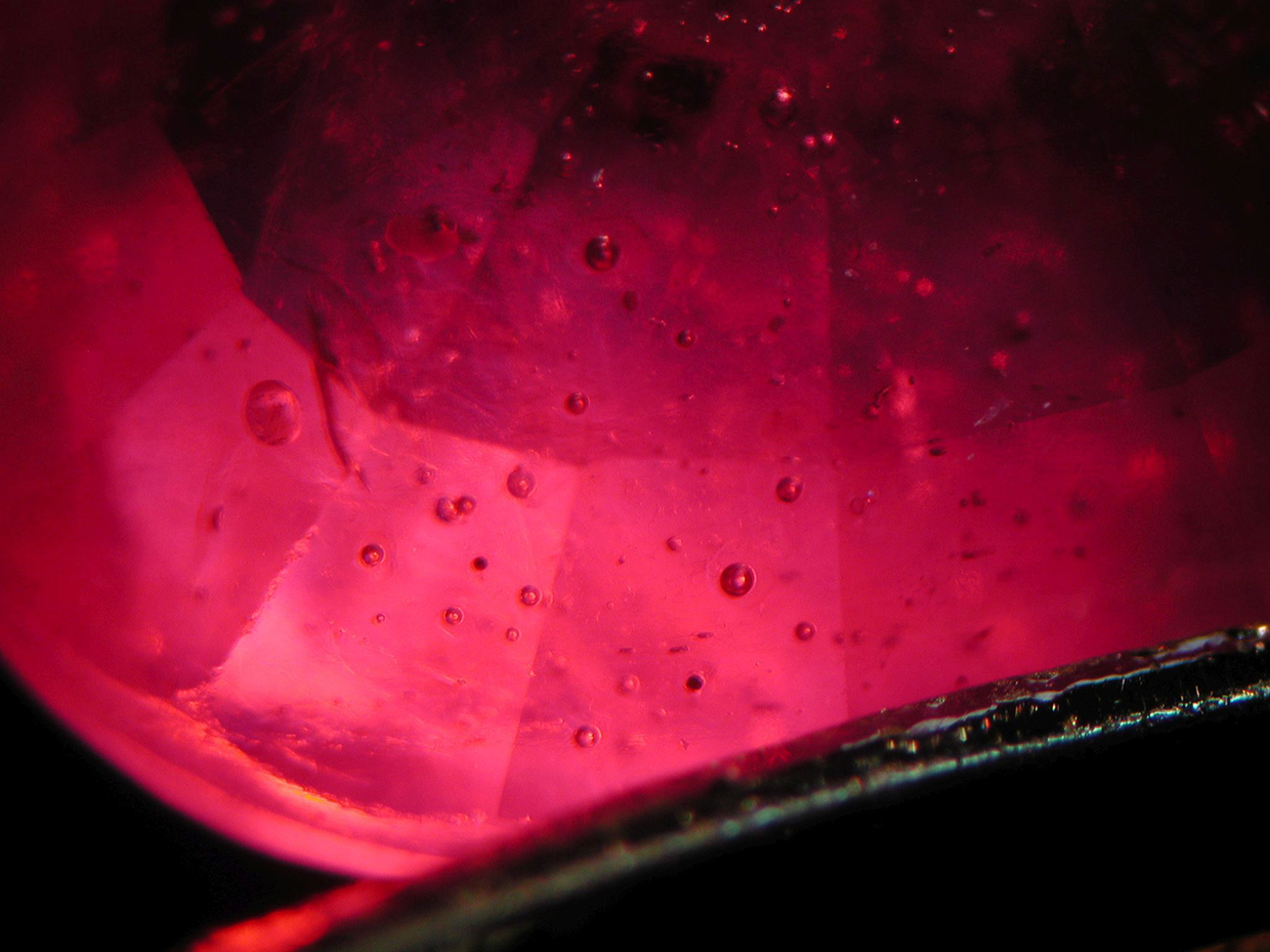
Some rubies are heated with a flux substance such as borax, to slightly meld or heal fractures. Gemological testing can also reveal this, and describes the treatment as a variation of the phrase "heated with residue". The apparent clarity is improved this way, and the stone altogether would probably look more clear compared to before.

Heat treatment is sometimes done with the addition of certain chemical elements. This often involves high temperatures in the hopes that the additives will permeate through the crystal's structure and induce an artificial color. 

We call this treatment "lattice diffusion" and while it's not as common as normal heat treatment, products of this enhancement are generally seen in the trade today.

Pale blue sapphire undergoes titanium diffusion to create a deeper darker blue color, while other corundum variety colors like that of Padparadscha can also be created using the diffusion of certain elements like Beryllium.

New ways of heating gemstones to produce color are being invented every day. Gemological knowledge is necessary to observe, detect and separate stones according to their corresponding identities so that proper disclosure and value assignments can take place in the industry. 

Today, about 95% of rubies and sapphires that make it to the jewellery trade are products of some form of heat treatment. It's one of the most accepted procedures in the industry as long as everything is met with openness and transparency.


Read more »
Gemcamp Laboratories
0 Comments

You Might Also Like

[name=Gemcamp Laboratories] [img=http://www.gemcamp.org/img/gemcamp-black-badge-3.jpg] [description=A Philippine-based laboratory group headed by GIA graduate gemologists who share a collective passion for the sciences that support gemstone identification and evaluation.] (facebook=https://www.facebook.com/gemcamplab/) (twitter=https://twitter.com/gemcamplab) (instagram=https://www.instagram.com/gemcamplaboratories/) (pinterest=https://www.pinterest.ph/gemcamplaboratories/)

Follow @Gemcamp Instagram